Key Considerations for PE Plastic Injection Molding
Polyethylene (PE), including LDPE, HDPE and LLDPE, is a widely used general plastic for injection molding. Its injection production requires targeted control based on the melt characteristics of different PE types, with strict management of raw material pretreatment, equipment, mold, process parameters and operation to ensure product quality and batch consistency. The core considerations are as follows:
1. Raw Material Pretreatment
PE has extremely low hygroscopy and no regular drying is required for raw materials stored in dry and ventilated conditions. For slightly damp raw materials, dry at 60~80℃ for 2~3h with the hopper insulated at about 50℃; high-temperature and long-time drying is strictly prohibited. Screen raw materials through an 80~100 mesh sieve to remove impurities and agglomerates, and avoid mixing different grades or types of PE raw materials.
2. Equipment and Mold Requirements
(1) Injection Equipment
Use general or PE-specific screws with a length-diameter ratio of 20:1~25:1 and compression ratio of 2.5:1~3.5:1; control screw speed at 30~60r/min (30~50r/min for LDPE, 50~70r/min for HDPE) to prevent shear overheating. Adopt open nozzles with an aperture of 2~4mm and ensure the barrel temperature fluctuation is within ±5℃.
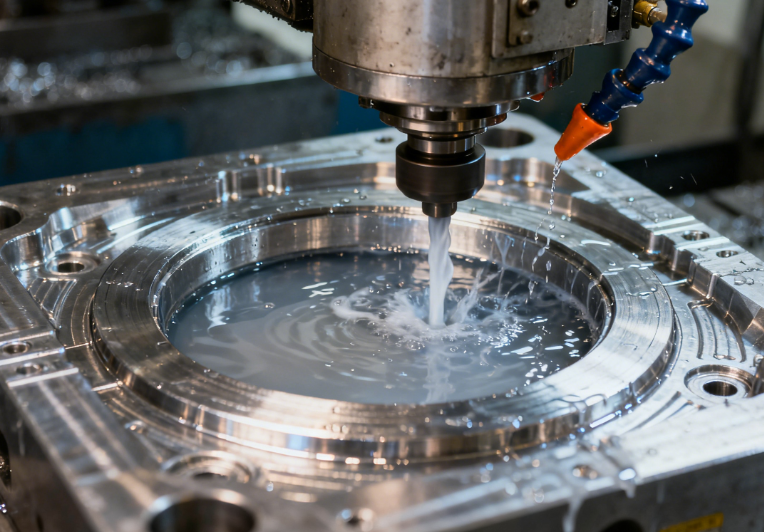
(2) Mold Design
Control mold temperature by type: 30~40℃ for LDPE, 40~60℃ for HDPE, 35~50℃ for LLDPE, with a local surface temperature difference ≤5℃ and cooling medium flow rate ≥0.5m/s. Reserve reasonable shrinkage allowance according to PE's high shrinkage rate (1.0%~3.0%), set draft angle at 1°~2°, polish the cavity surface (Ra0.8~1.6μm), and design gates matching the product structure to avoid stress concentration.
3. Process Parameter Control
Follow the principle of low material temperature, adaptive pressure and medium injection speed, with targeted adjustment for different PE types:
(1) Barrel Temperature (from front to rear)
LDPE: 140~160℃, 160~180℃, 180~200℃ (nozzle:170~190℃);HDPE: 160~180℃, 180~200℃, 200~220℃ (nozzle:190~210℃);LLDPE: 150~170℃, 170~190℃, 190~210℃ (nozzle:180~200℃).Temperature shall not exceed 230℃ to prevent melt degradation.
(2) Injection and Holding Pressure
Injection pressure: 60~90MPa for LDPE, 80~120MPa for HDPE, 70~100MPa for LLDPE (increase by 10~20MPa for thin-walled products). Holding pressure is 50%~70% of injection pressure, with holding time of 5~15s (increase by 1~2s for each 1mm product thickness).
(3) Injection and Cooling Speed
Adopt medium-high speed for thin-walled products and medium-low speed for thick-walled products; control cooling time at 3~15s (judged by non-deformation and non-sticking after demolding).
4. Production Operation Norms
Clean the barrel with PE regrind or PP before startup (increase temperature by 10~20℃). For short shutdown (10~30min), insulate the barrel at 140~160℃; empty the barrel for long shutdown (>1h). Control screw back pressure at 0.5~2MPa, monitor temperature in real time, and clean nozzle and mold exhaust slots regularly. Place demolded products on a shaping rack to avoid extrusion deformation.
5. Defect Troubleshooting
Bubbles/cavities: Dry raw materials at low temperature, reduce barrel temperature, slow injection speed and clean exhaust slots;
Shrinkage/warpage: Increase holding pressure/time, raise mold temperature and optimize cooling water channels;
Cold spots: Raise nozzle/mold temperature, enlarge gate and increase injection speed;
Short shot: Increase injection pressure/temperature and optimize mold exhaust;
Sticking/deformation: Lower mold temperature, increase draft angle and repolish the cavity;
Yellowing/brittleness: Reduce barrel temperature/screw speed and shorten melt residence time.
6. Safety and Quality Control
Store PE raw materials away from fire sources and take anti-scald protection during operation. Calibrate temperature control systems and pressure sensors every 3 months. Conduct first article inspection before mass production and record core parameters for traceability. Store finished products in a normal temperature, dry environment to avoid aging from sun exposure.
In summary, PE injection molding focuses on matching process parameters to different PE types and ensuring uniform mold cooling. Precise control of barrel temperature and injection pressure, combined with standardized operation and timely defect troubleshooting, can effectively improve production efficiency and product batch consistency.