Key Guidelines for Material Selection in PE Injection Molds
Polyethylene (PE) is one of the most widely used general?purpose plastics, valued for its low density, high toughness, chemical resistance, and excellent processability. It finds extensive applications in packaging, construction, home appliances, automotive parts, and more. The selection of mold materials for PE directly impacts mold life, part quality, and production efficiency. It must align with PE’s inherent characteristics—such as low viscosity, high shrinkage, and non-corrosiveness—and match the specific production scenario, including volume, precision requirements, and part type. This article presents a systematic, data?driven approach to mold material selection for PE, incorporating over 15 industry?recognized parameters.
1. PE Material Characteristics and Core Selection Logic
Three key properties define the boundaries of mold material selection for PE:
Shrinkage: LDPE typically shrinks by 1.5%–3.0%, while HDPE shrinks by 2.0%–4.0%. This requires mold materials with excellent dimensional stability to prevent cavity deformation during long?term production.
Melt behavior: PE melts have low viscosity and moderate flowability, resulting in relatively low wear on mold cavities. However, PE is prone to sticking, so mold materials must offer good polishability and release properties.
Chemical inertness: Unmodified PE is non?corrosive, but reinforced or filled grades (e.g., glass?fiber?reinforced PE) demand higher wear resistance or corrosion resistance.
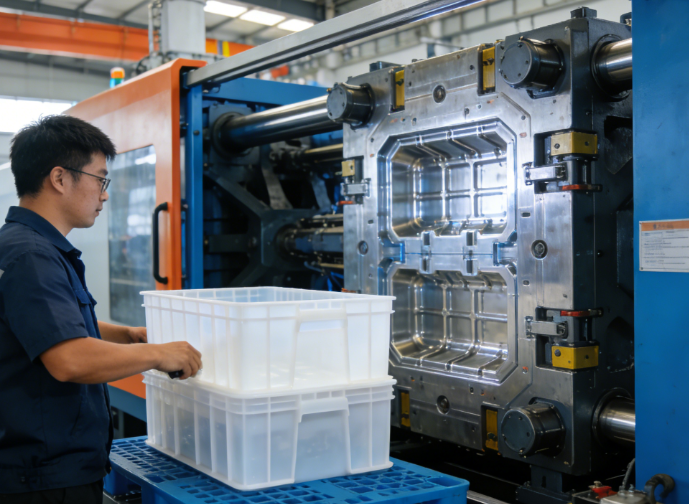
The industry?accepted selection logic follows a “performance?cost balance”:
For low?to?medium volume production, prioritize cost?effective prehardened steels.
For high?volume, high?precision production, prioritize heat?resistant and fatigue?resistant materials.
For modified PE, prioritize wear resistance.
For non?critical structural components, use low?cost structural steels to optimize overall mold cost.
2. Scenario?Based Material Selection for PE Molds
(1) Low?to?Medium Volume Civil Products
For items such as LDPE bottle caps, HDPE storage boxes, and other consumer goods produced in volumes up to 100,000 shots, P20 is the standard choice.
Prehardened to HRC 28–32, requiring no post?heat treatment.
Reduces machining time by approximately 30%.
Cost ranges from 30–50 RMB/kg.
Well?suited for PE’s low?wear characteristics.
For parts requiring slightly higher precision (e.g., thin?walled HDPE containers with IT 12 tolerances), 718 (a modified P20 grade) is preferred:
Offers better polishability, achieving Ra 0.2–0.4 μm.
Cost is 20%–30% higher than P20.
(2) High?Volume, High?Precision Products
For high?volume items such as HDPE crates, industrial pipe fittings, and precision components (150,000+ shots), H13 (equivalent to SKD61) is the industry standard:
Heat?treated hardness: HRC 48–52.
Sustains long?term operation at temperatures up to 600℃.
Excellent thermal fatigue resistance, suitable for high?cycle production.
Mold life can exceed 150,000 shots, 50% longer than P20.
For food?contact parts or products requiring a high?gloss finish, S136 (stainless steel) is ideal:
Hardness: HRC 52–54.
Mirror?polishable up to #15,000 grit, achieving Ra ≤ 0.01 μm.
High corrosion resistance, suitable for 2,000,000+ shots without rust.
Ensures compliance with food safety regulations.
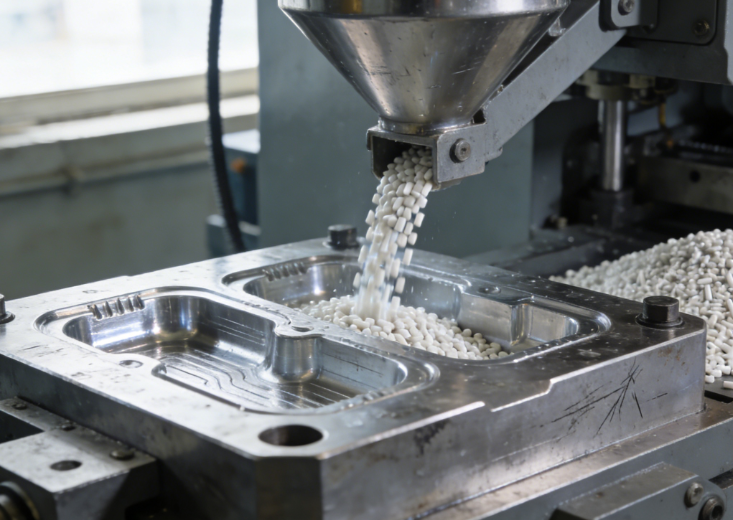
(3) Modified PE Products
Glass?fiber?reinforced PE and mineral?filled PE are highly abrasive. For these applications, Cr12MoV or ASP23 (powder metallurgy steel) are preferred:
Cr12MoV:
Vacuum heat?treated to HRC 60–62.
Wear resistance is 5× that of P20.
Effectively resists erosion from glass fibers.
ASP23:
Uniform microstructure, 50% more homogeneous than conventional steels.
Hardness: HRC 62–64.
Mold life can be twice that of Cr12MoV.
Ideal for high?wear, high?volume modified PE production.
(4) Non?Critical Structural Components
For guide pins, guide bushes, and mold bases, 45# steel or T8 carbon tool steel are sufficient:
45# steel:
Quenched and tempered to HRC 22–28.
Tensile strength ≥ 600 MPa.
Cost: 15–25 RMB/kg.
T8 steel:
Hardness: HRC 55–58.
Suitable for wear?prone components like guide pins.
Reduces overall mold cost by more than 40%.
3. Key Considerations for PE Mold Materials
(1) Surface Treatment
PE’s high toughness increases the risk of sticking. Regardless of the mold material:
Cavity surfaces should be polished to Ra 0.2–0.4 μm (for cosmetic surfaces) or Ra 0.8–1.6 μm (for non?cosmetic surfaces).
For highly adhesive modified PE, nitriding is recommended:
Raises surface hardness to HRC 60+.
Reduces friction coefficient to ≤ 0.15.
Enhances wear resistance and release.
(2) Compliance with Food Safety Standards
For food?contact PE products, cavity materials must comply with GB 4806.9?2016.
Use stainless steels such as S136.
Avoid materials containing heavy metals or impurities that could migrate into the part.
(3) Heat Treatment and Design
For wear?resistant steels like Cr12MoV, use vacuum heat treatment to limit thermal stress to ≤ 150 MPa and prevent cracking.
Prehardened steels (P20/718) should not be reheat?treated, as this can reduce hardness by HRC 5–8 and shorten mold life.
Design 0.01–0.02 mm vent gaps to prevent gas trapping during PE filling, ensuring compatibility with the mold’s surface finish.
Summary
Selecting materials for PE molds requires a systematic approach that balances material properties, part requirements, and production conditions. For low?to?medium volume consumer goods, P20 and 718 offer the best cost?performance ratio. For high?volume precision parts, H13 and S136 ensure long life and dimensional stability. For modified PE, Cr12MoV and ASP23 provide the necessary wear resistance. Non?critical components can use low?cost structural steels to optimize overall cost. By integrating industry?recognized data—such as hardness, shrinkage, and corrosion resistance—and following best practices for surface treatment and heat treatment, manufacturers can achieve optimal mold performance, part quality, and production efficiency for PE injection molding.